BEST WEBSITE FOR DAILY POPULAR WORLD TOP NEWS - JTN: World
Showing posts with label World. Show all posts

Friday, May 8, 2020

Victory Day May 8: What if the post-World War II 'world order' changed?

May 08, 2020 0
Victory Day May 8: What if the post-World War II 'world order' changed?

Victory Day May 8: What if the post-World War II 'world order' changed?

More than anything else, it was the war that reshaped our world.
Victory in Europe, or VE Day, was clearly not the last chapter of the battle. Japan was to be completely defeated. But still it was an important milestone that was an important step towards a new kind of global order.
The United States emerged as a military superpower after the war, surpassing Moscow in the development of nuclear weapons, which has become an important symbol of the global superpower.
But Russia is not far behind. Its decision to control much of Eastern Europe has somewhat dashed expectations of a new order with less confrontation.
This gave birth to NATO and established seemingly permanent military and diplomatic relations between the United States and Western Europe. This week, journalist and historian Ann Applebaum said in a webinar on the Royal United Services Institute's website that "it gave birth to the idea of ​​the 'West: a coalition of values ​​that includes not only borders but also ideas." Yes. '
But it was not just NATO. As Professor Michael Clarke puts it, there was a whole network of different institutions.
According to him, "very little pre-war structure of international institutions remained. And even more than 1919, there was a conscious thought that there was a need to re-create the world order from 'debris'.
He says the founding of the United Nations played a key role, followed by Bretton Woods' economic system, the IBRD (World Bank) and the IMF. Britain had a lot of influence, but American power was decisive.
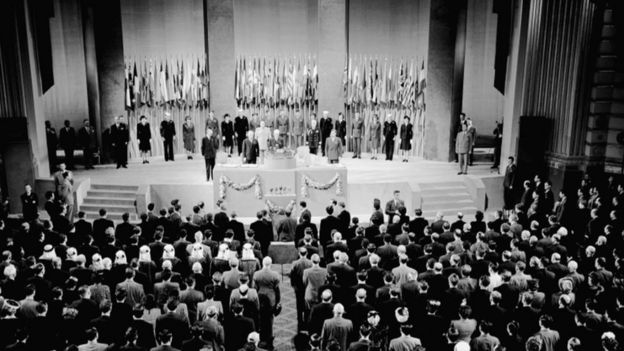
The United Nations was established in 1945 and now has 193 membersImage copyrightJTN IMAGES
Image caption1945 The United Nations is established and has 193 members
Professor Michael Clarke says: "Almost all international organizations relied on American interests and support for their stability. In the 1950s and 1960s, a highly regulated international system evolved from the clutches of Western-dominated institutions. There is a lot of pressure on the order based on these rules now because its political support is changing significantly.
Because of this, it is an essential part of our daily news agenda.
This is the Rising China, the shift of economic power in Asia and the Far East, and it is a growing popular trend in many Western democracies.
Look at the obvious tensions in NATO, for example, due to President Donald Trump's questions about what matters to the United States, and the emergence of authoritarian regimes in allied countries such as Turkey and Hungary.
Journalist and historian Ann Applebaum says the Republican Party in the United States has been dominated by a one-sided approach to foreign policy. She says there are some cracks in the Western values ​​system and generational change means that very few politicians have anything to do with the immediate post-war era.
Ignorance of today's history is another problem.
China has not emerged in recent times. He has been one of the future members of the UN Security Council since its inception.
"The United States has always been very concerned about China, both before and during the war," said Michael Clarke.
Although not much is said about it, according to Michael Clarke, "the United States has always viewed pre-communist China as a major power in the New World Order, naturally in the presence of ancient empires such as France and Britain." Will be able to bring balance.
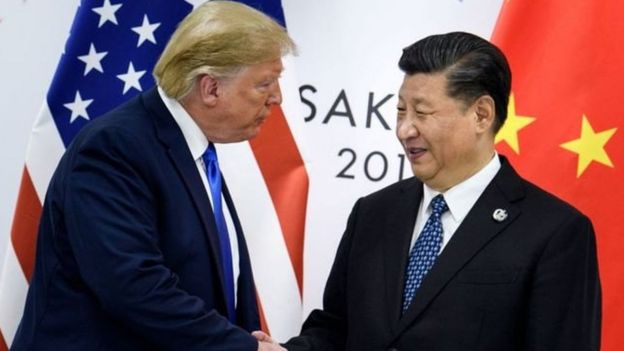
Chinese President Xi Jinping and TrumpImage copyrightJTN IMAGES
Image captionThings with China have become more tense under President Trump
"That's why the United States was so upset when China fell to the Communists in 1949," he said. He did not recover from this tragedy until 1972, and now, perhaps because of China's role in the world, he is once again suffering from the 'Syndrome of Dislocation'.
Lawrence Friedman, a professor at King's College, agrees, but says that during the Cold War, "China had a different problem." In the 20th century, China was not considered an economic and technological threat, as it is today.
Michael Clarke says Washington's "fall" has become more symbolic of the end of post-war order. However, he acknowledged that their numbers were not enough to defeat Washington's bid for independence.
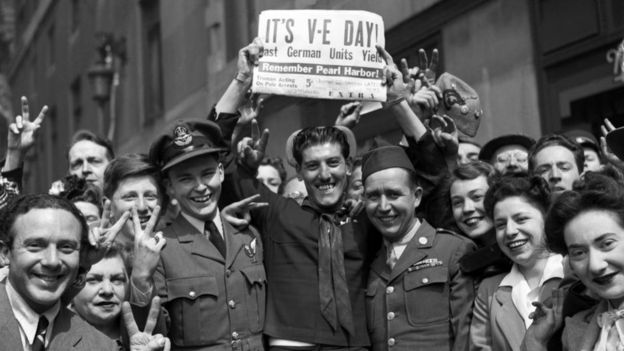
May 8, 2020 marks the 75th anniversary of the end of World War II in EuropeImage copyrightJTN IMAGES
Image captionMay 8, 2020 marks the 75th anniversary of the end of World War II in Europe
"The emerging world order is based on the simple fact that more than half of the world's population now lives within a circle that could be drawn around India, China and Southeast Asia," he said.
"It drives the economic geography of the world, and it gives rise to national political power and then international political structures."
So what will change, if any, because of the Code 19 crisis?
Michael Clarke says the post-epidemic world will not be the 'Asian Century' or the century of Asia, but its effects will likely create real inconsistencies in the decades to come.
He thinks the crisis will hurt China in the long run. Because of the political backlash in tackling the issue, and also because of the emerging power and national estimates of supply chains that rely heavily on China.
It is probably too early to predict what the post-Code 19 international system will look like.
But it can be said that the public service and solidarity that emerged after World War II was also intertwined in post-war life. It is good that this feeling is still there, but unfortunately all the signs are the opposite.

Thursday, May 7, 2020

Spanish flu: How did the world change after the 1918 global epidemic?

May 07, 2020 0
Spanish flu: How did the world change after the 1918 global epidemic?

Spanish flu: How did the world change after the 1918 global epidemic?

If you hadn't heard of the global flu pandemic before, now that the corona virus has spread, you probably know that the world became infected with a deadly virus even in the early 20th century.
Known as the 'mother of global epidemics', the epidemic killed between two and 50 million people between 1918 and 1920, in just two years.
Scientists and historians believe that a third of the world's 1.8 billion people were affected by the epidemic.
And in those days the Spanish flu killed more people than it did in World War I, which was coming to an end.

Now that the world is in the throes of the Cowboys-19 crisis, let's take a look back at what the world looked like after the last epidemic, in which everything came to a standstill.

1921, a completely different world


Compared to the corona virus today, science at that time had limited resourcesImage copyrightJTN IMAGES
Image captionToday, science has limited resources compared to the corona virus

Of course, much has changed in 100 years.
Medicine and science at that time were much more limited than today to deal with a disease.
Doctors knew that the spread of Spanish flu was caused by germs that could spread from person to person, but they thought that these germs were bacteria, not viruses.
Treatment was also available on a limited scale. The world's first antibiotic was discovered in 1928.
The world's first vaccine against the flu came into being in the 1940s.
Most importantly, there was no universal system of health in the world, and even in rich countries, sewage was considered a waste.
Laura Spini, author and scientist who has written a book on the Spanish flu, says: They had no access at all.

Young and poor


The flu pandemic of the early 20th century was also unique in that it killed more young people.Image copyrightJTN IMAGES
Image captionThe flu pandemic of the early 20th century was also unique in that it killed more young people.

To make matters worse, the Spanish flu struck in a way that had never been seen before in global flu pandemics, such as the 1889-90 pandemic, which killed more than a million people worldwide.
The majority of its victims were between the ages of 20 and 40, and there were far more males than females. This was probably due to the fact that the epidemic started in the crowded camps on the Western Front and as soon as the houses of the soldiers involved in the First World War were looted, it also brought the epidemic.
Poor countries were also badly affected by the epidemic.
A 2020 study by Faring Bravo, a researcher at Harvard University in the United States, estimates that the Spanish flu affected 1.5 percent of the US population (5.5 million people), compared to 5.2 percent in India (17 million). People) were affected.
Catherine Arnold, author of Pandemic 2018, says that the economic crisis left behind the loss of life caused by World War I and the Spanish flu.
According to him, in many countries, to run a business, work in the fields, get training in various fields, even get married and raise children so that they can take the place of the millions who died, the youth were no more.
"The lack of qualified men has led to a problem called 'spare women', which has left millions of women unable to find a suitable partner," she said.

In women jobs


Women work in a British factory.  World War I and the Spanish flu kill large numbers of men, giving women the opportunity to take up jobsImage copyrightJTN IMAGES
Image captionWomen work in a British factory. World War I and the Spanish flu kill large numbers of men, giving women the opportunity to take up jobs

Although the Spanish flu did not bring about major changes in society, such as the Black Plague, which ended the feudal system in the 14th century, it did shake the gender balance in many countries.
According to research by Christine Blackburn, a researcher at Texas A&M University, the lack of jobs in the United States has created job opportunities for women.
"By 1920, 21% of employees were women," she says.
That same year, Congress passed the 19th Amendment, which gave American women the right to vote.
According to Blackburn, the 1918 flu affected women's rights in many parts of the world.
Wages also increased due to a shortage of workers.
U.S. government records show that within the industrial sector, the rate rose from 21 cents per hour in 1919 to 56 cents per hour in 1920.

Effects on newborns


Babies in a maternityImage copyrightJTN IMAGES
Image captionResearch studies in several countries have found that children born during an epidemic were at higher risk of disease and were less likely to find work.

According to the research of scientists, diseases like heart disease were found in more children born during the Spanish flu than children born before or after the epidemic.
According to an analysis conducted in Britain and Brazil, people born in 1918-19 were less likely to enter college and take up regular jobs.
Some theories conclude that the pressure of the global epidemic on the mother may have affected the development of the baby in the womb.

Emotions against colonialism and global cooperation


GandhiImage copyrightJTN IMAGES
Image captionGandhi and other nationalists intensified their resistance to the British Raj when the plague reached India

By 1918, a century had passed since British rule in India.
There was an outbreak of the Spanish flu in May and it affected the locals more than the British there. Statistics show that the death rate among Hindus considered lower caste was 61.6 per thousand while nine deaths per 1000 among European citizens.
Indian nationalists took advantage of the impression that the British rulers had failed to deal with the crisis properly. In 1919, the magazine 'Young India', published under the auspices of Mahatma Gandhi, slammed the British authorities.
He wrote in his editorial: "The government of any other civilized country would not have shown such incompetence against a very terrible and deadly epidemic as the government of India has done."

After the 1918 epidemic, new systems were created to monitor and control the epidemicImage copyrightJTN IMAGES
Image caption After the1918 epidemic, new systems were created to monitor and control the epidemic.

The epidemic also highlighted the need for global cooperation after World War I.
In 1923, the League of Nations, the forerunner of the United Nations, announced the establishment of the 'Health Organization'.
It was a technical or technical body run by medical experts rather than diplomats and who devised a system to deal with global epidemics.
The World Health Organization was established in 1948.

Progress in the field of public health


Ministries of health were formed in many countries in the 1920s, or modernized.Image copyrightJTN IMAGES
Image caption In the1920s, health ministries were established in many countries, or they were modernized.

The damage caused by the Spanish flu pandemic highlights the need for progress in the field of public health.
Russia was the first country to introduce a central public health system in 1920. Soon after, other countries did the same.
Laura Spaniard writes: 'In 1920, many countries established new health ministries or modernized them.
"It was a direct result of the global epidemic, during which public health officials were either absent from cabinet meetings, or left at the mercy of other departments for money and authority," he said. '
Jennifer Cole, an anthropologist at the Royal Holloway University in London, says the global epidemic and war have sown the seeds of a welfare state in the politics of most parts of the world.
Explaining her point, she says that the provision of welfare came into being against a background of a large number of widows, orphans and the disabled.
"Global epidemics shed light on society," he said. Because of them, the society becomes more equal and just.

Lockdown and social distance worked


People gather outside a San Francisco church in the United States in 1918.  Social distance also played an important role during the 1918 epidemicImage copyrightJTN IMAGES
Image captionPeople gather outside a San Francisco church in the United States in 1918. Social distance also played an important role during the 1918 epidemic

This is the famous story of two cities: the campaign to promote war bonds in the cities to cover the expenses of the ongoing war in September 2018 was in full swing and processions were being held in this regard.
Meanwhile, when the Spanish flu epidemic broke out, the two cities adopted very different approaches. Philadelphia continued the procession as planned, while St. Louis canceled the celebrations.
A month later, more than 10,000 people died in Philadelphia due to the epidemic. The death toll in St. Louis was less than 700.
This difference in the two different attitudes towards the epidemic strategy emerged as an argument in favor of social distance.
An analysis of measures such as the ban on public gatherings in many American cities in 1918, and the closure of schools and places of worship, shows that the death rate remained lower in the cities where this was done immediately.
Analyzing the 1918 lockdown, American economists have concluded from their research that in the cities where these measures were strictly followed, economic recovery also accelerated after the end of the global epidemic.

The forgotten epidemic


Manch's self-portrait is one of the few examples of art and literature about the 1918 epidemic.Image copyrightPUBLIC DOMAIN
Image captionManch's self-portrait is one of the few examples of art and literature about the 1918 epidemic.
Brazilian President Rodriguez Elvis died of the Spanish fluImage copyrightHANDOUT
Image captionBrazilian President Rodriguez Elvis dies of Spanish flu

Despite the lessons learned, the Spanish flu has been forgotten in many ways.
One reason for this is the First World War, during which many governments banned the publication of war-related news.
Then our history and literature is also devoid of mention of it.
But Wood-19 has certainly reminded people of that.

Enter your email address:

Delivered by FeedBurner